Meeting of Tax Administrators: Challenges and Opportunities (I). On human resources

Recently, with the collaboration of AECID, AEAT and the DGI of Uruguay, the Inter-American Center of Tax Administrations organized the First Meeting of Tax Administrators, with the participation of Tax Directors from Latin America, Europe and Africa. The objective of this meeting was to share the administrators’ assessment of the different challenges they face in institutional management and the fulfillment of their objectives, as well as to propose various scenarios as an opportunity to mitigate risks and effects of current and future challenges in the short and medium term.
As part of the results of this exercise, we have published Opportunities and Challenges of Tax Administrations[1], where the results achieved are shared, our thanks to all the sponsors and especially to the tax administrators for their critical attitude and open to a constructive and very fruitful dialogue. With this blog, we started a series dedicated to the thematic blocks of the meeting. The first one was Human Resources.
This first block focuses on the challenges and opportunities in human talent management within tax administrations. Ten challenges key are identified, where the loss of talent it is the most critical, highlighting factors such as retirements, pauperization and wage competitiveness and working conditions. The limitation of personnel and the lack of alignment with required competencies are also mentioned as significant concerns.
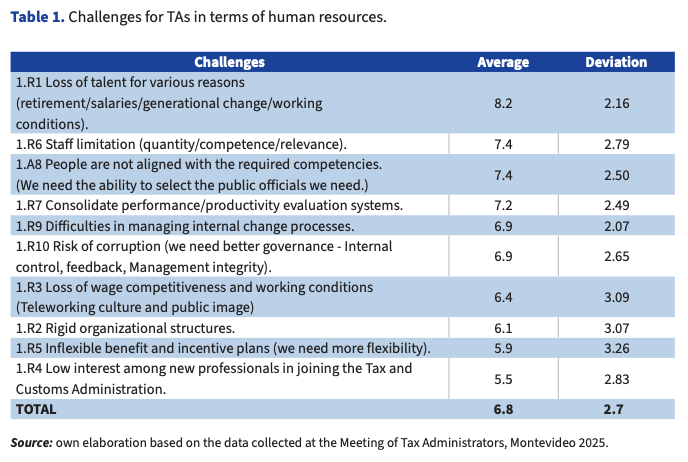
The administrations recognize the the importance of innovation in the training and continuous development of its teams, emphasizing a proactive approach to ensure quality and effectiveness in human resource management. This includes the creation of more robust and flexible assessment systems that allow adapting to the changing needs of the tax sector.
Human Resources in other thematic blocks
There were five thematic blocks that were organized for the meeting, and we noted that practically in all of them the issue of human talent was present. In the block of technology, the lack of technology-trained personnel is highlighted and limits the implementation of new digital tools. Here, the recruitment and retention of human talent in technology is identified as a essential challenge.
In the block of institutional management, mention is made of the need for fostering a tax culture to support the continuous training of staff, improving the public image of administrations and their effectiveness. The internal coordination and the support to other government entities are also linked to the quality of the available human resource.
In the block of fiscal system, it is suggested that proper human resource management can facilitate the implementation of new regulations that affect the tax administration, such as those related to crypto-assets and digital services.
Opportunities to Improve Human Resource Management
Our meeting did not only seek to prioritize the challenges that have become evident in one way or another in developing countries. An analysis was also conducted to propose improvement actions that address the different problems and several opportunities to improve human resources management in tax administrations. These include:
- Development of continuing education programs that align with the competencies required in the current environment.
- Review of attraction and retention policies that respond to the new labor dynamics, ensuring that administrations can compete effectively for talent.
- Implement more flexible and coherent performance evaluation systems, to allow a better alignment between the demands of the administrations and the realities of the personnel.
- The competency-based training management, which gets the highest score and is considered crucial for performance improvement.
In addition, it is suggested that international cooperation can be key to strengthening the capacities of administrations in human resources management, as happens in other areas of tax activities. Offering learning and development opportunities through collaboration and the exchange of good practices.
In summary, the document emphasizes the importance of properly managing human resources in tax administrations to face the current challenges and take advantage of future opportunities. Investing in the development of human talent not only improves the efficiency and effectiveness of administrations, but also contributes to a fairer and more transparent tax environment. Please consult this report in case you want to know more about the Administrators’ discussion on human talent and the other thematic blocks.
References:
[1] Inter-American Center of Tax Administrations CIAT (2026). Opportunities and Challenges of the Tax Administrations. CIAT Tax Administrators Meeting, 2025. [Event held in Montevideo, Uruguay, from October 15 to 17, 2025, organized by the CIAT with the collaboration of the Spanish Agency for International Cooperation – AECID and the General Tax Directorate of the Republic of Uruguay- DGI]. https://marketing.ciat.org/PW-EN-pub-OC
[2] CIAT (2020). Page. 5.
2,326 total views, 4 views today