
Global Inventory 2025: where are tax administrations and where are they going in the field of digitalization and digital transformation? Part 2.

- Introduction
In the first installment of this series (Part 1) [i] I pointed out that the report on “Digitalization initiatives and digital transformation of the tax administration” [ii], prepared from the data of the “Inventory of Tax Technology Initiatives” [iii] and fed by the “Global Survey on Digitalization” [iv], is structured around the six pillars of the Tax Administration 3.0 approach[v]:
- Digital identity.
- Points of contact with the taxpayer.
- Data management and standards.
- Management and application of tax regulations.
- New competences.
- Governance frameworks.
In this second part we delve into the pillar (1) “Digital Identity” [vi], understood — for the purposes of the aforementioned global survey and the Tax Administration 3.0 approach – as the electronic representation of a person or company that allows them to be properly identified in their online interactions. This identity includes attributes associated with a credential used to authenticate the user or the entity in their digital interactions with the tax administration and, where appropriate, with third parties.
From a strategic perspective, digital identity is not only a mechanism for accessing tax services, but also a critical digital public infrastructure, indispensable for enabling advanced cooperative compliance models, secure exchange of data in real time and automation of the application of tax regulations (rules as code). In this sense, it stands as one of the foundations on which the transition to fully digital tax administrations is articulated.
The global report evidence that, in most jurisdictions, the use of a digital identity approved by the administration has become a standard practice. Approximately two-thirds of the countries report that between 81% and 100% of people use digital identity to access secure tax services. The level of adoption is even higher among companies, where about 90% of tax administrations indicate that more than 80% of the companies use digital credentials in their dealings [vii].
Also, the global report highlights that a small number of administrations are beginning to incorporate emerging technologies in their digital identity systems: self-sovereign identity (9.4%), digital identity wallets (13.5%), and artificial intelligence (5.7%). No administration reported the use of blockchain for these purposes[viii].
It is important to note that the global report also addresses other fundamental components of digital identity — such as interoperability, authentication models, proxy delegation, security levels, and attribute verification — which interested readers are encouraged to review directly in the original document. In this installment, the analysis focuses exclusively on two particularly relevant dimensions: (a) the levels of adoption among people and companies, and (b) the use of emerging technologies, both on a global scale — as we have already indicated above – as well as, in thirteen (13) Latin American and Caribbean (LAC) countries selected based on clearly defined methodological criteria, which are then developed.
(2) Development
2.1) Justification for the selection of countries
The analysis focuses on 13 LAC countries, which are: 1) Argentina, 2) Brazil, 3) Chile, 4) Colombia, 5) Costa Rica, 6) Cuba, 7) Ecuador, 8) Guatemala, 9) Honduras, 10) Mexico, 11) Paraguay, 12) Peru and 13) Uruguay.
The selection responds to three main methodological criteria:
- Availability of information in the “Inventory of Tax Technology Initiatives”, as of October 1, 2025: by having complete, structured, and comparable data in the OECD Data Explorer [ix].
- Belonging to the Spanish-American and Portuguese-American bloc: this guarantees a common base of legal and administrative traditions that improves regional comparability.
- Representativeness and institutional diversity: including large economies (Brazil, Mexico, and Argentina), medium-sized economies (Chile, Colombia, and Peru) and emerging economies (Costa Rica, Paraguay, Uruguay, Cuba, Guatemala, Honduras, and Ecuador).
In summary, the 13 countries analyzed simultaneously meet criteria of ✔ availability of data; ✔ linguistic-institutional homogeneity; ✔ regional representativeness. These criteria also offer a replicable methodological basis for comparative studies in other regions.
2.2) Digital identity: a key enabler for Tax Administration 3.0 in LAC
As is well known, digital identity is the foundation on which the tax modernization is based. A unique, secure, and interoperable identification allows:
- Guarantee legal certainty about the identification of the taxpayer.
- Enable the secure and real-time exchange of data.
- Allow digital representation at different levels.
- Provide automated services integrated with tax rules.
- Reduce administrative frictions and improve the taxpayer experience.
Without a robust digital identity system, it is impossible to move towards the 3.0 Tax Administration model. In this context, digital identity should be understood as an enabling legal-digital infrastructure, on which the remaining pillars of the model are based.
2.3) Level of adoption of digital identity in LAC
2.3.1) Adoption of digital identity among people in LAC
Consistent with the global outlook, LAC countries show important progress, although with significant differences:
High levels (81-100%): Argentina, Chile, Colombia, Costa Rica, Ecuador, Paraguay, Peru, and Uruguay.
Intermediate levels (41-60%) (61-80%): Guatemala (61-80%), Brazil (41-60%) and Mexico (41-60%).
Extremely low levels (0-20%): Cuba and Honduras.
These gaps show the need to strengthen digital inclusion, improve the availability of credentials, increase digital literacy, and expand access to connectivity services.
2.3.2) Adoption of digital identity among companies in LAC
Unlike the behavior observed in people, the adoption of digital identity among companies is highly homogeneous and consolidated in LAC:
- Use of the 81-100 % in most countries.
- Honduras has a low level (21-40%).
- Guatemala did not report data.
Table 1. Percentage of adoption of “Digital Identity” in LAC (people and companies)
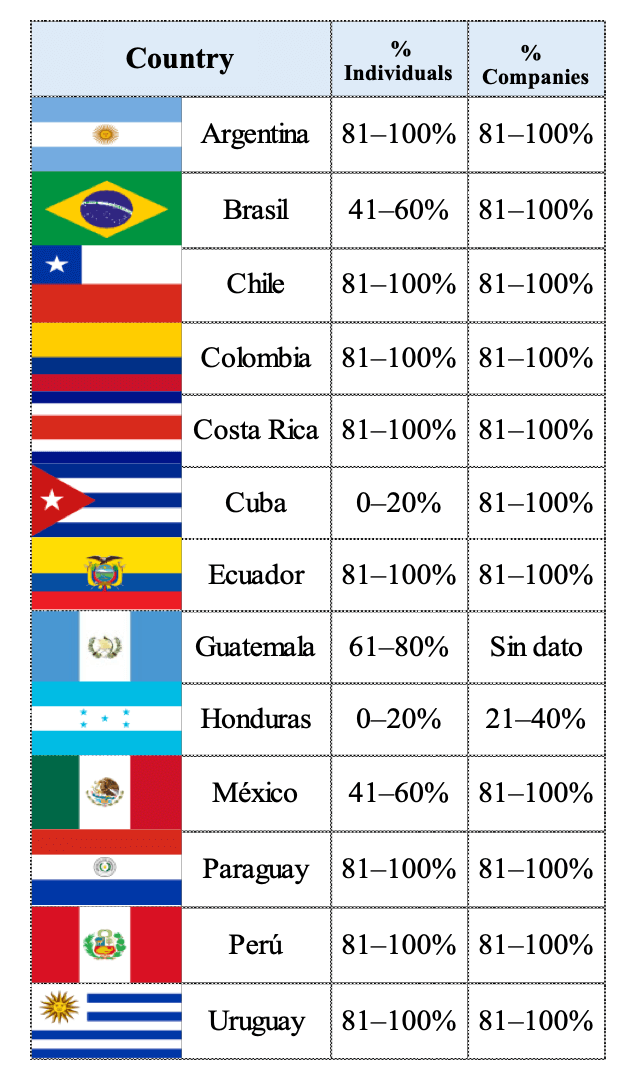
Source: OECD, Inventory of Tax Technology Initiatives, available as of 1 October 2025 (OECD Data Explorer). Table created by the author.
2.4). Use of emerging technologies applied to digital identity in LAC
The global report shows that only a minority of tax administrations use advanced technologies in the field of digital identity. This behavior is almost identically reflected in LAC. In many cases, these technologies are implemented under pilot schemes or partial solutions, rather than as fully integrated architectures.
LAC countries that do incorporate emerging technologies:
- Brazil: digital wallet.
- Chile: digital wallet.
- Cuba: digital wallet.
- Ecuador: digital wallet + AI.
- Guatemala: blockchain + other advanced solutions.
- Mexico: self-sovereign identity + Digital wallet + other solutions.
LAC countries that do not report the use of emerging technologies:
Argentina, Colombia, Costa Rica, Honduras, Paraguay, Peru, and Uruguay.
From a comparative perspective, while between 5.7% and 13.5% of the main tax administrations in the world apply emerging technologies, in LAC only 6 of the 13 countries analyzed report such initiatives. Adoption is still limited, but strategic, with relevant signs of innovation in Mexico, Ecuador, and Guatemala.
- Conclusions
The LAC region has succeeded in institutionalizing digital identity, especially in the business sector. However, significant gaps in individual adoption persist, associated with factors of digital literacy, access, and technological capacity.
The use of emerging technologies is still incipient, although promising experiences that could become regional benchmarks are identified. In this context, effective alignment with the Tax Administration paradigm 3.0 requires moving towards:
- Higher levels of interoperability.
- Common standards of digital identity.
- Strong data governance; and
- A progressive adoption of advanced technologies in line with institutional maturity.
For ALC, the challenge no longer lies solely in adopting digital identity, but in evolving towards interoperable, scalable, and dependable models, avoiding fragmented solutions that limit the transformative potential of this infrastructure. Responsibly managed, digital identity is consolidated as an essential enabler of tax modernization at a global level.
4) Next installment (Part 3)
The next installment will address the analysis of pillar (2) Points of contact with the taxpayer, evaluating how LAC tax administrations are modernizing their digital and face-to-face channels, as well as their degree of alignment with the principles of Tax Administration 3.0.
References:
[i] https://www.ciat.org/inventario-global-2025-donde-estan-y-hacia-donde-van-las-administraciones-tributarias-en-el-ambito-de-la-digitalizacion-y-transformacion-digital-parte-1/
[ii] OECD (2025), Digitalization initiatives and digital transformation of the tax administration, OECD publications, Paris, https://doi.org/10.1787/c076d776-en (Accessed on August 16, 2025).
[iii] OECD (2024), Inventory of tax technology initiatives, https://www.oecd.org/content/oecd/en/data/datasets/inventory-of-tax-technology-initiatives.html (Accessed on August 16, 2025).
[iv] https://www.oecd.org/content/dam/oecd/en/topics/policy-issue-focus/inventory-of-tax-technology-initiatives/global-survey-digitalisation-2024-en.pdf (Accessed on December 16, 2025).
[v] OCDE (2020), Administración tributaria 3.0: La transformación digital de la administración tributaria, Publicaciones de la OCDE, París, https://doi.org/10.1787/ca274cc5-en (Consultado el 16 de diciembre de 2025).
[vi] OECD (2022), Tax administration 3.0 and the digital identification of taxpayers: initial findings, OECD Forum on Tax Administration, OECD Publications, Paris, https://doi.org/10.1787/3ab1789a-en .
[vii] Page 17 OECD (2025), Digitalization initiatives and digital transformation of tax administration, OECD Publications, Paris, https://doi.org/10.1787/c076d776-en (Accessed on December 16, 2025).
[viii] Page 17 OECD (2025), Digitalization initiatives and digital transformation of tax administration, OECD Publications, Paris, https://doi.org/10.1787/c076d776-en (Accessed on December 16, 2025).
[ix] Inventory of Tax Technology Initiatives available, as of 1 October 2025, in the OECD Data Explorer (Accessed 16 December 2025).
5,639 total views, 2 views today